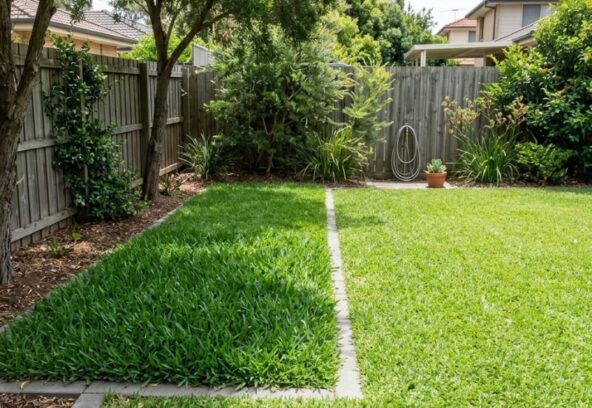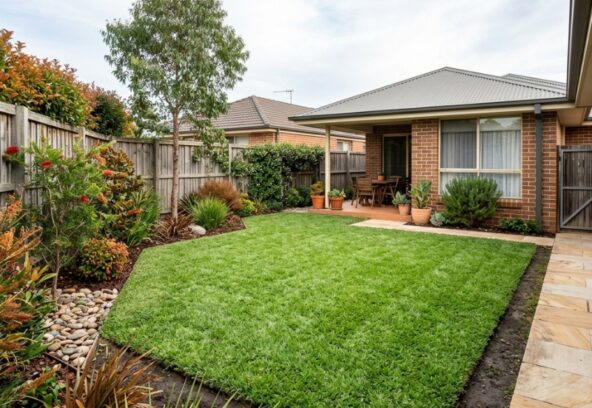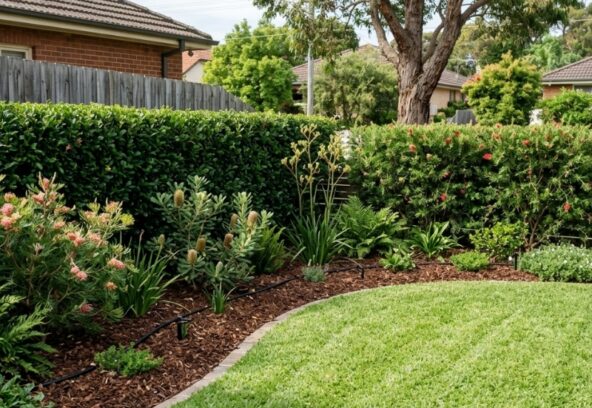
You are standing at the turf supplier with two pallets in front of you, one Sir Walter Buffalo and one Kikuyu, and to the eye they are just two slabs of green grass. Nothing about them tells you which one will still look good against your back fence in two years. Here is the short version: for most Sydney backyards, the choice comes down to how many hours of direct winter sun the lawn actually gets, and from there it is simple. Buffalo wins in shade, kikuyu wins on wear. This article gives you a way to measure that for your own yard before you order, so you buy the variety that suits your block rather than the one on the nicest pallet.
Measure your winter sun before you choose anything
Before you compare a single variety, go and measure the thing that actually decides this: how much direct sun your lawn gets in the middle of winter. Not summer, winter. This one measurement tells you more than any turf chart will.
Pick the shadiest part of the lawn, the spot that struggles or the side nearest a fence or a neighbour’s house, and check it three times on a clear day in June: at 9 am, at midday, and at 3 pm. June is the month to do it because Sydney’s sun sits at its lowest, which is exactly when a two-storey neighbour, a paling fence or a big tree throws shade right across a backyard that bakes in full sun come December. Write down roughly how many hours of direct sun that shadiest patch gets across the day. That midwinter number is the one that matters, because it is the worst case the lawn has to survive, and a lawn that holds up in June will romp through summer.
This is also why so many Sydney lawns thin out on one side while the rest looks fine. Every turf tolerance chart online quietly assumes a flat, unshaded block, which almost no real backyard is. Your own measured number beats any chart.
Sir Walter buffalo: the shade option
Sir Walter buffalo is a soft-leaf buffalo with a broad, flat blade that feels pleasant underfoot, none of the scratchiness older buffalo varieties was known for. If you have ever avoided buffalo because you remember it as coarse, this is a different thing.
The main reason to choose it is shade tolerance, full stop. Buffalo copes with less sun than kikuyu or couch, holding its colour and density in spots where the others would thin and go patchy, which is what makes it the default for a backyard with a fence line, a big tree or a two-storey neighbour casting shade across part of the lawn. It also holds its colour better through a Sydney winter than kikuyu does, staying greener for more of the cold months rather than browning off. Through summer it handles the heat well and stays looking full.
Be clear on the trade-offs, though. Buffalo is slower to repair itself, so a bare patch from heavy wear or a dog’s favourite track takes longer to fill back in than it would on kikuyu, because buffalo spreads by runners above the ground rather than racing across it. And it is the dearer pallet of the two, so you pay more up front for the shade tolerance. Buffalo is the pick for the under 3 hours band, and the better choice through much of the 3 to 5 hours band too.
Kikuyu: the wear option
Kikuyu sits at the other end. Where buffalo is the shade grass, kikuyu is the workhorse, and the two read side by side neatly.
The main reason to choose it is fast growth and self-repair. Kikuyu grows vigorously and knits itself back together quickly, so the bare patch that would sit for weeks on buffalo fills in fast on kikuyu. That is exactly why it copes so well with children and dogs: a lawn that gets hammered by a trampoline, a cricket pitch or a dog running the same line every day recovers on its own between weekends. For a genuine family backyard in good sun, nothing takes a beating and bounces back like kikuyu.
The honest downsides are the flip side of that vigour. Kikuyu goes dormant and loses colour through a Sydney winter, browning off more than buffalo does in the cold before greening up again in spring. It needs mowing more often than buffalo, because the same fast growth that repairs wear also means it is forever pushing upward. And it will run into your garden beds if the edges are not physically held, sending runners under and over any border that is not a proper hard edge, so it asks for a bit more edge discipline than buffalo. Kikuyu needs good sun to do all this well, so it is the pick for the more than 5 hours band, and the rear end of the 3 to 5 hours band if the lawn takes a hammering.
What about couch and zoysia?
Buffalo and Kikuyu are not the only two on the pallet rack, so briefly, the other two are worth knowing. Couch is the fine-leaf, full-sun option: it gives a lovely tight, manicured finish and loves heat, but it needs plenty of sun and more attention to look its best, so it suits an open, sunny block where you want a sharp-looking lawn. Zoysia is the middle-ground choice: slower growing than kikuyu so it needs less mowing, with reasonable wear and a decent feel, but it sits at a higher price and establishes more slowly. Worth considering if you want less mowing than kikuyu and can wear the higher cost and slower start. For most Sydney backyards, though, the real decision stays between buffalo and kikuyu.
A simple way to decide
Pull it together in three steps, and the choice makes itself:
- Match your measured winter sun to a band. Under 3 hours points firmly to buffalo. More than 5 hours opens up kikuyu and couch. The 3 to 5 hour middle is where the next two steps decide it.
- Narrow by how hard the lawn gets used. Kids, a dog, constant traffic in the same spots all favour Kikuyu’s self-repair. A lawn that is mostly looked at rather than lived on can take buffalo.
- Narrow by how much mowing you will actually do. Happy to mow often, Kikuyu is fine. Want less of it, lean to buffalo or zoysia.
Here is the same information at a glance:
| Variety | Minimum winter sun | Wear tolerance | Mowing frequency | Winter colour |
| Sir Walter buffalo | Low (handles shade) | Moderate, slow to repair | Less often | Holds colour well |
| Kikuyu | High (needs good sun) | High, fast self-repair | More often | Browns off, dormant |
| Couch | High (full sun) | High, fine finish | More often | Browns off in cold |
| Zoysia | Moderate | Moderate | Least often | Partial colour loss |
One more thing feeds into this: timing. The variety you pick still has to go down at the right point in the year to take properly, so it is worth reading up on when to lay turf in Sydney before you lock in an order, because even the right variety struggles if it is laid at the wrong time.
Getting the ground right matters more than the variety
Here is the part people skip, and it undoes everything above: the best variety in the world, laid on unprepared ground, will fail. You can measure your sun perfectly, order exactly the right turf, and still end up with a thin, struggling lawn if the ground underneath was not got ready first. Preparation matters more than the name on the pallet.
Remove the old lawn and roots completely: Simply mowing the existing lawn low and laying new turf over it can leave roots and thatch that prevent the new turf from properly knitting into the soil.
Level the ground: A level surface helps prevent hollows that collect water and bumps that can cause the mower to scalp the lawn.
Prepare the soil: The soil needs to be loosened and properly prepared so the new turf roots can establish and grow downwards instead of sitting on a hard crust.
Get the groundwork right: Proper preparation gives suitable turf the best chance to establish and thrive. Poor preparation can leave even high-quality turf struggling.
Use professional turf laying: This is the work our turf laying service handles, helping create the conditions for a lawn to establish properly rather than continually struggle.
Measure first, then order
If you take one thing from all this, make it the winter sun measurement. Standing in that shadiest corner in June with a rough count of your direct-sun hours is the single most useful thing you can do before you order a pallet of anything, because it turns the whole buffalo-versus-kikuyu question into a straightforward answer. If you would rather have someone measure the site and tell you what will actually hold up in your yard, our team can walk the lawn with you and recommend a variety; check out our turf-laying service.